

It has taken me seven or eight years to stop bringing a sweater in case it gets cold.
I live on the Gold Coast in Queensland, where for most of the year the idea of needing an extra layer is borderline absurd. And yet the habit persisted, long after it stopped making any practical sense.
Denmark is my first home. I was born there and lived there for twenty-eight years before moving to Australia. Whenever I go back, I relish the cold in a way that surprises even me. Long pants and sleeves, woollen sweaters even on grey summer days, and that particular dry crispness in the air. I love the ease of a warm climate. But I am, at some fundamental level, a person who belongs in the cold.
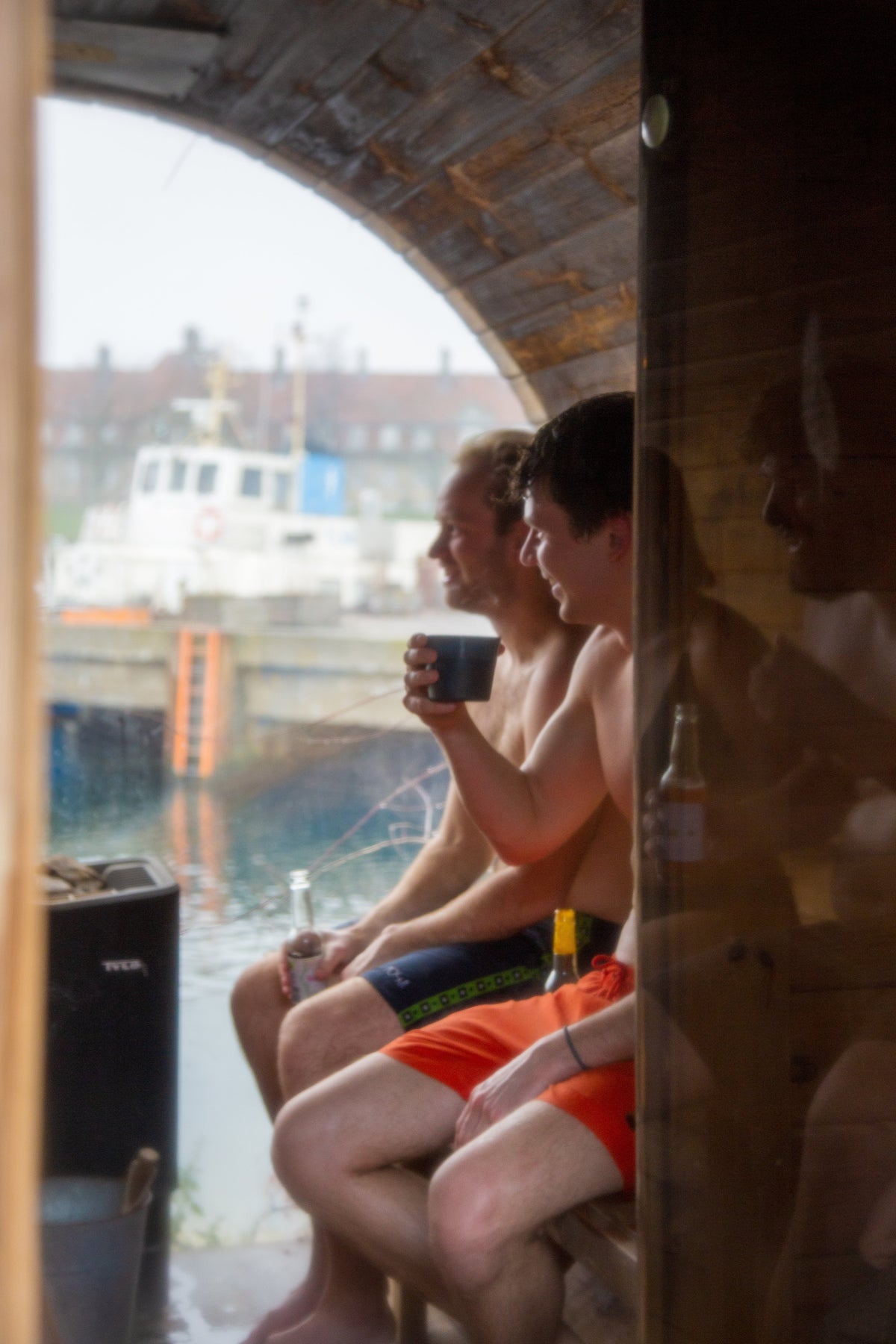
One of the ways I got through Nordic winters was, paradoxically, by getting even colder. I would jump into the ocean or the harbour and then head to the sauna, or sometimes skip the sauna altogether and warm up on the bike ride home. It was a ritual I shared with friends. That last part matters, because Nordic winters aren’t just cold. They are dark, long, and, if you let them be, deeply isolating. You don’t drift through them passively; you actively construct ways to stay connected to yourself, but more importantly, to other people.
This instinct runs deep in Nordic culture. The oldest still existing winter bathing club where I come from in Denmark, Helgoland, has been open since 1929. It has moved, but never closed. Not for a pandemic, not for a war, not even for the kind of February where you have to crack a hole in the ice to even get in the water. Every single week for well over a century, people have shown up, taken off their clothes (yes, all of it), and stepped into freezing water together.
Places like Helgoland have been practising what is now being called “social wellness” long before anyone thought to give it a name.
And as it turns out, you do not need a Nordic winter to understand the need for somewhere to put down the weight of a long week, work through a difficult decision, or simply sit with another person in comfortable silence. Around the world, wellness spaces are being reimagined not as facilities for individual recovery but as genuine social infrastructure offering real connection, emotional release, and somewhere to be that isn’t home or work.
This is where I want to take you. Back to the places that shaped my understanding of what feeling well can look like. Most of the places in this guide are not an escape from the messiness of everyday life, but an integration of it. They are not luxury retreats, though some of these places are genuinely beautiful. It’s a collection of water-based spaces across the Nordic countries where community is the main offering and cold is the means. Some I know intimately. Some I am still working my way toward. All of them are worth your time.
La Banchina, Refshaleøen, Copenhagen
The right way to reach La Banchina is by bike. Rent one in the city, cross the canals via the cycling bridge in Nyhavn, and let the waterfront lead you North to Refshaleøen, which is a former industrial peninsula that has in recent years become one of the most interesting corners of Copenhagen.
Part natural wine bar, part restaurant, part harbour bath, La Banchina occupies a small wooden dock and a modest wooden shack on the Refshaleøen waterfront. Blink and you might walk straight past it. It is unpretentious in the way that only genuinely confident places can be.
Once you step in, there is an ease to this place that immediately lets your shoulders down. You can swim directly from the dock. You can eat simply prepared, organic food. You can drink something good and watch the water and the sunset without really noticing that hours have gone by.
A hidden gem that is no longer quite hidden, but has somehow retained its unique quality despite the attention. Open year round, with a small barrel sauna available to book for private sessions.


Sofiebadet, Christianshavn, Copenhagen
Sofiebadet in Christianshavn has been open since 1909, and stepping inside is like entering a pocket of time. Similar to the Japanese onsens or Turkish hammams, it was originally built to improve hygiene among working-class families at a time where most Copenhagen apartments had no bath or shower of their own. Few places are preserved as completely, both functionally and aesthetically, as Sofiebadet. It is a living museum of one of the city's most vital institutions. The egalitarian layout with rows of shower niches and bathtubs side by side tells a vivid story of a place that has been receiving people for over a century.
The nature of the place has naturally shifted over time. Today it doubles as a cultural space, with a programme that includes croquis drawing, meditation courses, and even footbath concerts.
I used to come here when I lived in Copenhagen, usually for a salt scrub in their beautiful dome-shaped hammam. I guarantee that you will walk out of there feeling like the freshest version of yourself.
Svinkløv Badehotel, Fjerritslev, Denmark
If you’re looking to step away from busy city life, Svinkløv Badehotel offers the perfect escape. A white wooden hotel set at the edge of the North Sea dunes on the west coast of Jutland, where the soft, diffused summer light lingers late into the evening and the coastline stretches uninterrupted in both directions.
Svinkløv was built in 1925 as part of the Danish “badehotel” tradition, shaped around a simple premise: you come for the sea, and everything else follows from that.
Days here are shaped by the weather, by meals, by when you choose to walk, swim, or simply sit still. There is no wifi. Instead there are board games, shared spaces, and cosy nooks made for reading.
In 2016, the hotel burned to the ground. It reopened in 2019, restored with a level of care and respect for the original that reflects how deeply the place has long been valued within the region’s history and culture.
My husband and I were married about thirty kilometres north of here, along a stretch of coast that has always reminded me of a Krøyer painting. I keep thinking Svinkløv would be the right place to return to, to mark our anniversary and relive some of the memories from that coastline.
The hotel is open from mid-April to early October. Closed through winter, but open long enough to catch the shift between seasons.


Ribersborgs Kallbadhus, Malmo, Sweden
Malmö is an easy detour from Copenhagen of just twenty minutes on the train across the Øresund Bridge. Besides a different language that only really sounds like a slight change of accent, you wouldn’t even notice you are in another country.
If you are dedicated to traditional bathing and sauna culture, a nude sauna experience is a rite of passage. Ribersborg is not a bad place to encounter it for the first time.
Built in 1898 and extending around two hundred metres out into the Øresund on wooden stilts, the structure is exposed but steady. It has repeatedly been damaged and partly rebuilt due to violent storms, but the idea of the place has remained intact.
The setup is traditional. Besides the fact that it is nude, it is also largely gender-separated, with different sauna and bathing areas for men and women. There is one mixed sauna available too.
Being nude in a sauna can feel confronting at first, but it is one of those great, equalizing experiences that is more liberating than what you might think.
After the water, there is fika served at the small onsite cafe. That is the Swedish tradition of pausing the day while enjoying coffee or tea, and something sweet. After a few cycles of hot and cold it arrives at exactly the right moment.

Salt, Oslo, Norway
When did we decide that the only place to be at eight o'clock on a weeknight was a bar? Salt in Oslo challenges that idea. A cultural space on the waterfront that combines Nordic bathing traditions with live music, open fires, and food grilled over flame. This place is looser and less categorisable than anything the wellness industry would recognise as its own. No marble or curated calm. Think makeshift structures, woodsmoke, and live music. You can book a private sauna, or experience Adna, one of the largest shared saunas in the world with capacity for a hundred people. Salt makes the case that taking care of yourself and being loud in good company are not mutually exclusive.


Löyly, Helsinki, Finland
Löyly calls itself a sauna restaurant, which is exactly what it sounds like. You come to eat, to sauna, and, if you're brave enough, to slip into the Baltic Sea for a cold dip in any order you prefer.
The name of the place alone is telling. Löyly refers to the steam that rises the moment water meets the hot stones of a sauna and creates a rush of heat that thickens the air and stings your face. It's a word that doesn't translate directly into any other language, which perhaps says something about how deeply Finnish this experience is.
Finnish saunas date back thousands of years, often traced as far as 7000 BC, and are recognised by UNESCO as part of the world's Intangible Cultural Heritage. But unlike traditional Finnish saunas, Löyly isn't nude or gender-segregated, which is compelling if the idea of stripping down is outside of your comfort zone.
The building, designed by Avanto Architects, sits on the waterfront just two kilometres from the city centre. It’s a distinct sculptural timber structure that folds itself along the shoreline, echoing the rocky Finnish coastline.
The order of the experience is entirely up to you, and you don't have to commit to both dining and sauna. But it's worth considering the full experience.
I have family just outside Helsinki that I'm long overdue to visit. Löyly has attached itself to that trip in my mind. I want to go in February, when the contrast of the hot sauna and the freezing Baltic Sea is at its most extreme. If I'm lucky, there'll be an avanto waiting: a hole cut into the ice, ready to jump in to cool down after the sauna just like the locals would do.

Sky Lagoon, Kópavogur, Iceland
My Icelandic friends like to joke that summer is the most beautiful day of the year. It is funny because it is largely true. You will not find much warmth in the Icelandic weather, but luckily you’ll find it in the ground. Iceland is defined by its geothermal landscape. Pools of naturally heated water have been part of daily life and restorative practice for centuries, with written references dating back to the twelfth century.
If you’re planning a trip to Iceland, you’ll almost certainly hear about the Blue Lagoon. It’s iconic for a reason with its milky blue water, dramatic surroundings, and conveniently close to the international airport. But it’s not the only option.
Sky Lagoon, which opened in 2021 just outside Reykjavík, offers a slightly different experience. The lagoon opens up to the North Atlantic Ocean. In winter, if conditions allow, you might find yourself watching the Northern Lights while sitting in the water held at a steady thirty-eight degrees.
The details feels considered here. Even the bathrooms and changing rooms carry the same textured, moody and slightly raw feeling. Turf roofing, cave-like tunnels, and raw finishes blur the line between the built and the natural in a way that blends in with the landscape.
Sky Lagoon is also known for their optional seven-step ritual, Skjól. The word translates loosely to shelter, retreat, or protection. The experience moves through a sequence of stages: warm lagoon, cold plunge, ocean-view sauna, mist, steam, scrub, and finishes with a closing shot of saft, a traditional elixir made from crowberries grown in the lava fields.
It’s a structured experience, more curated than traditional bathing culture, and not necessarily rooted in a specific historical practice. But there’s something to be said for a well-designed ritual that helps you slow down and move through the elements with intention.
GeoSea geothermal sea baths in Húsavík and The Vök Baths in are also worth a visit if you plan to travel around Iceland.

Fjord Sauna, Flåm or Aurland, Norway
This isn’t somewhere you’re likely to stumble upon. Our co-founder Nick visited a few years ago and has mentioned more than once since that the journey through the landscape is part of what makes it worthwhile. Getting there means heading deep into Vestland County, well beyond the usual routes.
Fjord Sauna has two locations on the Aurlandsfjord, a branch of the Sognefjord, the longest and deepest fjord in Norway. Both are floating saunas with uninterrupted views across the water and the steep mountains that rise directly from it. Run by locals who have spent enough time in this landscape to know exactly how to place you within it. Large glass windows in the sauna frame the landscape from inside the heat. And when the temperature becomes too much, a hatch in the floor opens directly to the fjord below for a quick plunge.
They also offer both shared and private Aufguss sessions. These are guided sauna rituals where water infused with essential oils is ladled over the hot stones in intervals, releasing waves of heat and scent. The steam is then moved through the room with towels or fans, creating a more immersive and intentional experience. Also referred to as saunagus, this style of sauna practice has been growing in popularity for good reason.
The two locations of Fjord Sauna are only about a fifteen-minute drive apart, but they are separate setups. If you’re making the journey out, it’s worth double-checking you’re heading to the right one.

Before you go
I'm going to leave you with a few practical notes worth keeping in mind.
- Book in advance where possible, as spots can fill quickly.
- Check the code of conduct before you arrive. Some places have specific rules around what to bring, what to wear or not wear, and what their specific social etiquette is.
- Pack a pair of slippers or thongs for wet outdoor surfaces and shared showers.
- Check opening hours carefully. Some places operate only during daylight, on certain days, or close entirely for parts of the year.
Share: